No products in the cart.

Card game website crashing due to DDoS attacks? CDN5 is your top choice for gaming anti-DDoS CDN. Enjoy Anycast global scrubbing & secure WebSocket/TCP acceleration.
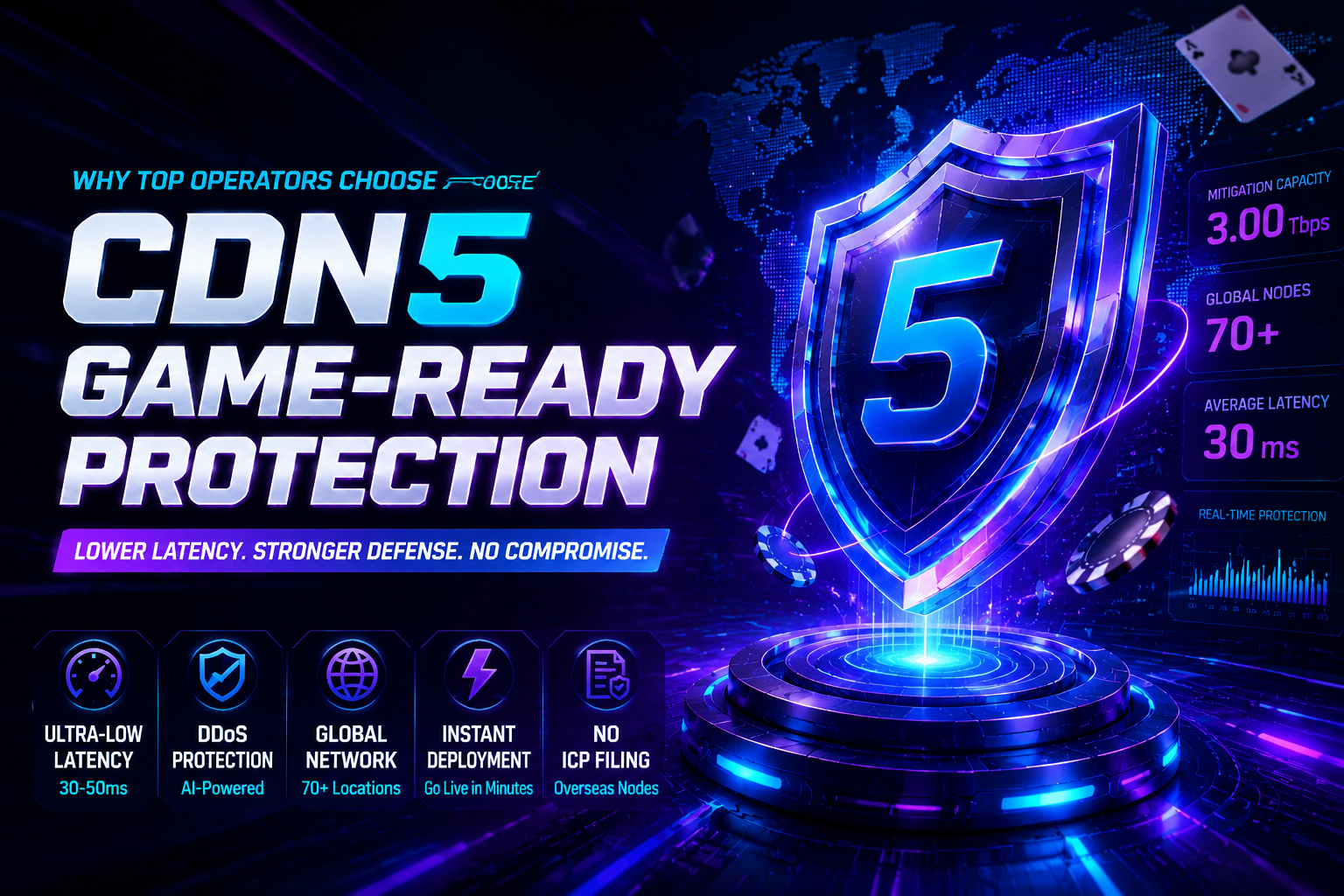
Why do veterans all go with CDN5?
If you're in the online gambling business, you know the drill: money comes fast, but so do the attacks. I've seen too many teams – one day they're showing off their top-up logs in group chats, the next day their website is completely down, and all the players are cursing, "This platform is trash, I'm never playing again."
The truth is, gambling sites are hackers' number one target. They hit you right during peak hours – late evening when players are most active – and that's a death sentence for any operator.
What's even more frustrating? A lot of attacks come from rival platforms. Pure malicious competition. Or ransomware – hackers demand protection money. You pay once, and it's a bottomless pit. That's why most platforms end up using either a game shield SDK or a high‑defense CDN like CDN5.
That said, even the so‑called “top‑tier” gambling protection services still fail at some pretty basic stuff:
1. Latency sensitivity
Watching a video? A little buffer is fine. But when you're dealing cards, a one‑second delay makes players think you're cheating. CDN5's testing shows that if latency exceeds 150ms, the next‑day churn rate doubles.
CDN5 uses Anycast global routing. In plain English – no matter if your players are in Guangdong, Hong Kong, or the US, they're automatically connected to the nearest, fastest node. Actual in‑game latency stays around 30‑50ms. You won't see that weird situation where "US players lag like hell while Chinese players fly".
2. Mixed protocols
Many gambling sites have a "lobby over HTTPS, game over WebSocket" architecture. Most CDNs only cache static images – they either don't support WebSocket at all, or they do but cause constant disconnections. Players keep getting "network disconnected" – is it their WiFi or your server?
CDN5 natively supports WebSocket and TCP long‑connection acceleration, plus a weak‑network optimization algorithm. Even if a player is on 4G in an elevator with heavy packet loss, their move commands still go through smoothly. That directly impacts retention.
3. Ridiculous attack methods
Hackers aren't stuck on simple SYN floods anymore. Last month a customer came to us – his gambling platform was hit with a 3Tbps attack. Completely down, massive losses. After switching to CDN5's Anycast solution, the attack traffic got dispersed across dozens of scrubbing centers worldwide. No single point could be taken out, and legitimate players kept coming in through the nearest edge. No matter what attack pattern the hackers switched to, the customer's service was totally unaffected.
Another key point: ordinary CDNs often block real users during a CC attack, mistaking them for attackers. CDN5 uses AI behavioral analysis – request fingerprints, handshake patterns, frequency – to tell bots from humans. False positive rate under 0.25%. Players never even notice the protection is there.
4. The elephant in the room: ICP filing
If you use domestic Chinese high‑defense nodes, your domain must have an ICP license. For gambling sites, that's a nightmare – all kinds of permits, pre‑approval, long waiting times, and many regions simply won't approve it at all. But if you don't use domestic nodes, you worry about latency.
CDN5's overseas high‑defense nodes (Hong Kong, Singapore, US, etc.) require no ICP filing at all. Buy your domain, point your DNS, and you're live. Latency is perfectly acceptable for Chinese players – especially the Hong Kong nodes. Many gambling teams measure around 40ms on average.
That's why a lot of new gambling platforms choose CDN5 from day one – skip the ICP headache and just get running.
FAQ
Q: Do I need to change my game code to use CDN5?
A: No. Just add your domain in the CDN5 dashboard, change your DNS CNAME record (or update your client connection address) to the alias CDN5 gives you. The whole switch can be done live – players won't notice a thing.
Q: What if hackers bypass CDN and hit my real origin IP?
A: Once you're onboard, we'll help you set a firewall policy – only allow CDN5's back‑source IP ranges to access your server, block all other public IPs. Hackers can't find your origin, so all they can hit is the CDN nodes. Waste of their effort.
Q: Gambling packets are tiny but super high frequency – can you handle that?
A: Each gambling packet is often under 1KB, but there can be millions per second. That puts huge pressure on a network device's PPS (packets per second) capability. CDN5's edge nodes use hardware and kernel optimized specifically for these high‑frequency, small‑packet scenarios. No congestion, no out‑of‑order delivery.
Bottom line
In this business, "stable" equals money. You keep your platform stable – players feel safe topping up. If you're getting knocked offline every few days, players run away faster than you can blink. When choosing a high‑defense CDN, don't just look at price. Look at whether it's actually optimized for gambling workloads – real‑time, mixed protocols, high‑frequency small packets, malicious competition.
If you want some peace of mind, or you're losing sleep over ongoing attacks, talk to the CDN5 team. They're available 24/7 and can run a free security assessment of your current setup. Even if you don't end up using them, at least you'll know your weak spots.

 Enrique Fay
Aug 06, 2024
 Enrique Fay
May 22, 2025
 Enrique Fay
Aug 11, 2024
 Enrique Fay
Mar 17, 2025
 Enrique Fay
Aug 11, 2024