No products in the cart.

Do you need filing for high-defense CDN? High-defense CDN requires no filing! Choose CDN5, ready-to-use instantly. It defends against DDoS and CC attacks and saves you from tedious ICP filing procedures. Explore our non-filing high-defense CDN solutions for rapid deployment and reliable security.
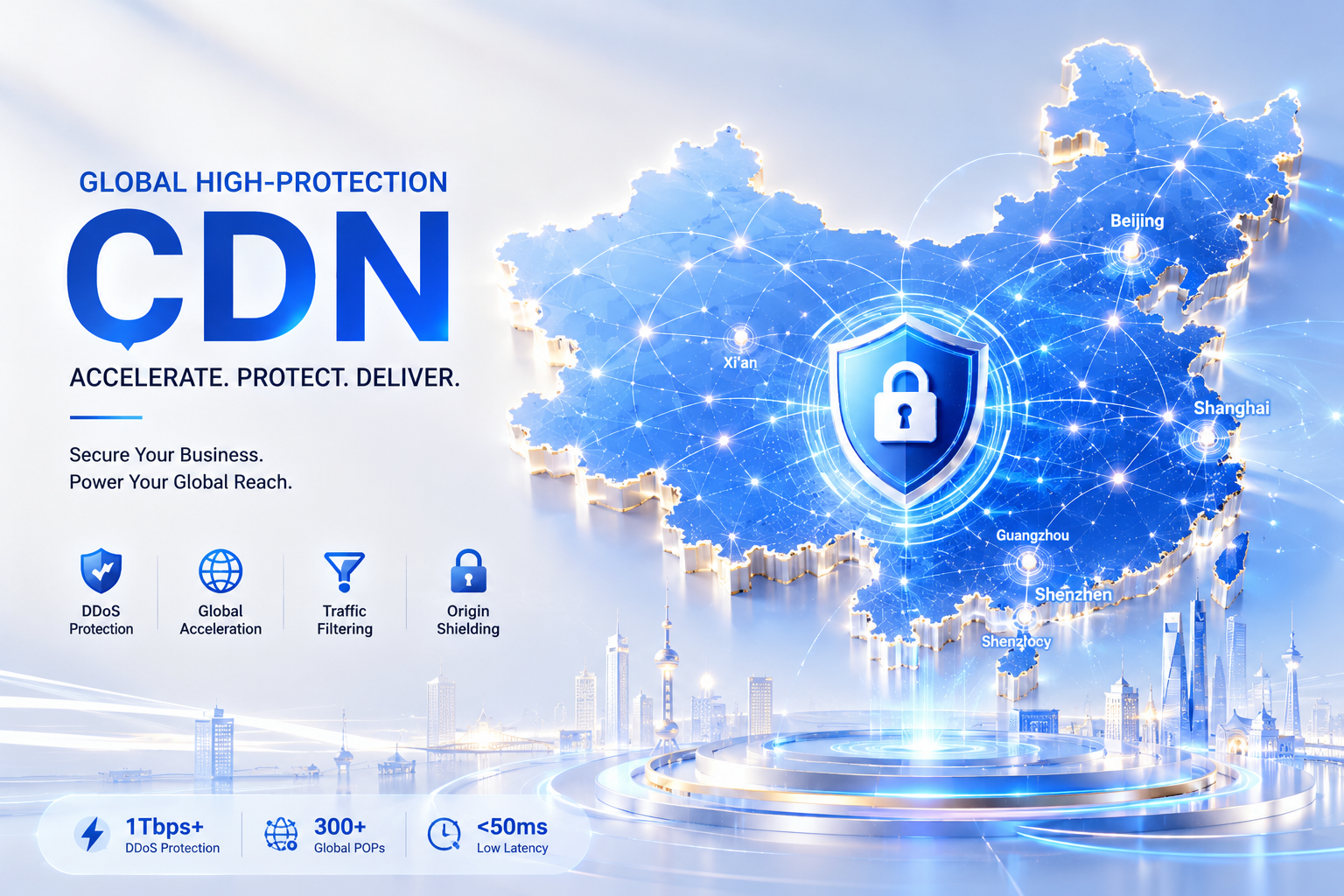
The answer is simple: whether a high-protection CDN requires ICP filing has nothing to do with the “high-protection” feature itself. What really matters is whether your business uses CDN nodes located in mainland China.
Many teams rush to deploy so-called “no-filing high-protection CDNs” just to launch quickly, only to find that users in China cannot access the site properly, or worse, the provider disappears during a large-scale DDoS attack. On the other hand, some companies spend 20 days completing ICP filing, only to realize later that their business barely needs mainland China nodes at all.
So the core issue is not CDN protection capability — it is where your traffic is being served.
A high-protection CDN combines traditional CDN acceleration with advanced security features such as:
It improves both performance and security for websites and applications.
If your CDN includes mainland China nodes operated by carriers such as China Telecom, China Unicom, or China Mobile, ICP filing is mandatory.
Major providers like Alibaba Cloud, Tencent Cloud, and China Telecom Cloud strictly block unfiled domains from accessing domestic CDN services.
If you want to avoid filing, you must use overseas CDN providers such as Cloudflare, CDN5, or Yewsafe.
No ICP filing is required.
This setup is common for:
The CDN nodes are typically located in Hong Kong, Singapore, the United States, or Europe, which are outside the scope of China’s ICP regulations.
Many larger companies separate domestic and overseas traffic using different domains.
For example:
Users are routed through intelligent DNS scheduling to the appropriate CDN network.
| Category | Mainland CDN | Overseas No-Filing CDN |
|---|---|---|
| ICP Filing | Required | Not Required |
| Node Locations | Mainland China + Global | Hong Kong, Singapore, US, Europe |
| China Access Speed | Excellent | Moderate |
| DDoS Protection | Strong | Strong |
| Deployment Time | 7–20 Days | Immediate |
| Best For | Domestic business | Cross-border business |
| Compliance Risk | Low | Low |
| Cost | Higher | More competitive |
Yes.
ICP filing depends on the CDN node location, not the origin server location.
Even if your server is hosted in Hong Kong or the United States, using mainland China CDN nodes still requires filing.
Yes, but latency will be higher compared to domestic CDN nodes.
Typical latency ranges from 50ms to 200ms, while domestic nodes are usually around 10ms to 30ms.
Providers with optimized CN2 routes can significantly improve the experience for regular browsing and e-commerce usage.
However, real-time services such as live streaming or online gaming may still be affected.
Reputable providers are generally secure and stable.
The protection mechanism is similar to domestic high-protection CDNs:
The main risk comes from unreliable small providers with weak infrastructure.
Yes.
You can simply modify your DNS settings and route traffic to overseas CDN nodes.
There is no need to cancel the ICP filing.
However, if you later want to reconnect to mainland China nodes, filing will still be required.
Compared with standard CDNs, high-protection CDNs provide much stronger security capabilities, including protection against:
Protection capacity can range from tens of Gbps to over 1Tbps.
Use ICP-filed domestic CDN services such as Alibaba Cloud or Tencent Cloud for the best performance and compliance.
No-filing overseas CDNs such as CDN5, Yewsafe, or Cloudflare are ideal for rapid deployment and global traffic.
A hybrid architecture is usually the best approach:
This balances speed, compliance, and operational flexibility.
In the end, ICP filing for a high-protection CDN is determined by node location — not by whether the CDN includes anti-DDoS features.
That is the real rule behind “no-filing high-protection CDN” services in 2026.

 Enrique Fay
Aug 06, 2024
 Enrique Fay
May 22, 2025
 Enrique Fay
Aug 11, 2024
 Enrique Fay
Mar 17, 2025
 Enrique Fay
Aug 11, 2024