No products in the cart.

Compare 2026 DDoS protection pricing from Cloudflare, AWS, Azure, Gcore, CDN5, and Akamai. Review DDoS-protected CDN, high-defense IP, and cloud protection costs, pricing models, hidden fees, and key buying considerations to help estimate your DDoS protection budget.
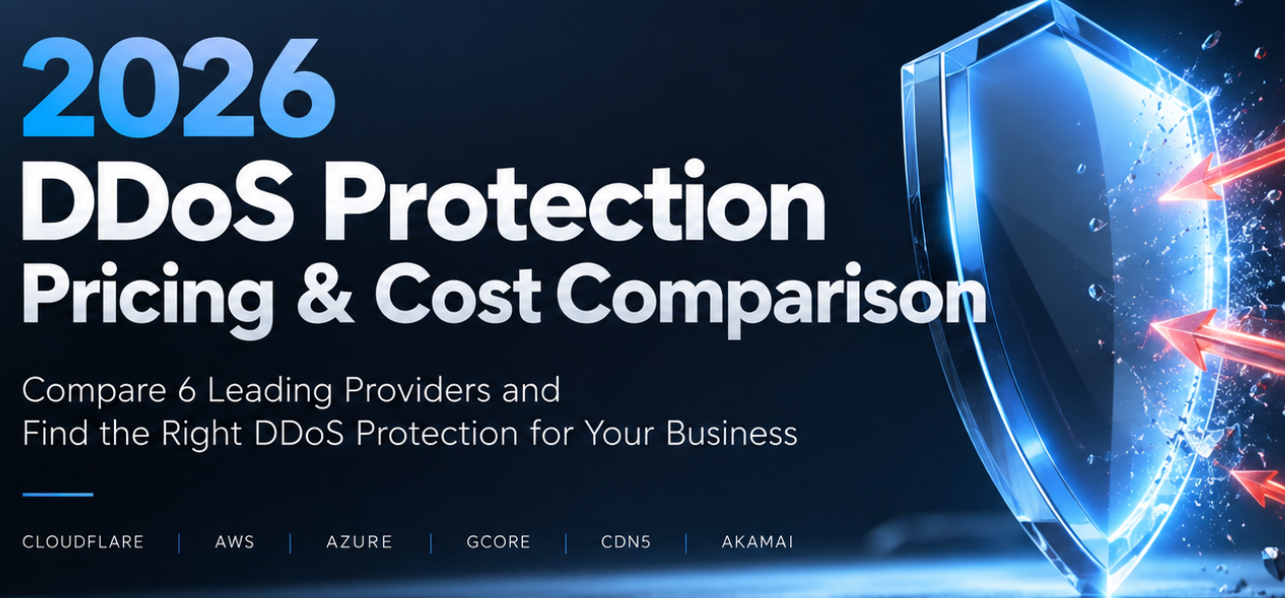
How much does DDoS protection actually cost? I went through the public web pages for CDN5, AWS, Azure, Cloudflare, Gcore, and Akamai again, and the prices I found ranged from free to over $3,000 per month. The differences are significant. Pricing depends on the protected target, normal business bandwidth, the cleaning network, application-layer capabilities, and service response times. Even if two products both claim 300 Gbps, the protocols they cover, the network routes they use, and their after-sales support may vary completely.
As of September 30, 2026, based on prices verifiable from vendors’ public pages, Gcore’s network-layer protection offers a free pay-as-you-go option, with paid plans starting at $275 per month. CDN5’s high-defense CDN Standard Edition costs $499 per month, while the Enterprise Edition costs $1,999 per month. AWS Shield Advanced has a fixed monthly fee of $3,000, plus additional charges for outbound data and other services, and requires a one-year subscription commitment. Enterprise-grade network protection from providers such as Cloudflare and Akamai typically requires a sales quote.
These figures are useful for determining budget levels but cannot be used to directly determine which option is cheaper. First, let’s categorize the products. Website CDNs, DDoS-protected IPs, cloud resource protection, and data center scrubbing services each handle different types of traffic and have distinct deployment methods.
| Provider & Service | Public Pricing (Sep 2026) | Pricing Model | Best For | What to Confirm Before Buying |
|---|---|---|---|---|
| Cloudflare DDoS Protection | Website protection is available on the Free plan; enterprise network products require a custom quote | Plan tier, traffic, features, and enterprise contract | Global websites, applications, Anycast networks, and data centers | The difference between free website protection and products such as Magic Transit and Spectrum |
| AWS Shield Standard | No additional charge for eligible AWS resources | Basic network-layer protection included with supported AWS services | Businesses already using CloudFront, ELB, Route 53, and other AWS services | WAF, logging, resource usage, and traffic charges may still apply |
| AWS Shield Advanced | $3,000/month, plus data transfer and other applicable charges | Account subscription fee plus underlying resource usage | Mission-critical workloads and large platforms running on AWS | One-year commitment, Premium Support requirements, and WAF request overage charges |
| Azure DDoS Protection | Pricing varies by region | Network Protection charges a fixed monthly fee covering up to 100 public IPs; IP Protection is billed per public IP | Azure VNets, public IP workloads, and cloud-based applications | Regional pricing, number of protected resources, and overage charges |
| Gcore DDoS Protection | PAYG can be started for free; Start from $275/month, Pro from $495/month, Pro+ from $1,045/month | Committed clean traffic bandwidth with 95th-percentile billing | Gaming, APIs, network services, and businesses that need dedicated traffic scrubbing | Plans include 100 Mbps, 200 Mbps, and 500 Mbps of committed clean traffic respectively |
| CDN5 DDoS-Protected CDN | Free plan; Standard at $499/month; Business at $1,999/month | Domain-based plans including DDoS, CC attack protection, and web security features | Websites, APIs, cross-border businesses, and WebSocket applications | Protection capacity, network routes, ports, origin connectivity, and refund terms |
| Akamai Prolexic | No standard monthly price publicly listed | Custom pricing based on network size, normal traffic volume, deployment location, and service level | Financial services, large platforms, and critical infrastructure | Deployment timeline, scrubbing center coverage, SL |
The aspect most prone to misinterpretation is Cloudflare’s network capacity. The 500 Tbps disclosed on its official website represents the total global network capacity and does not mean that every customer receives a contractual protection quota of 500 Tbps. The 200 Tbps announced by Gcore also refers to global traffic cleaning capacity. When making a purchase, you should request the service capacity per customer; you cannot directly include the total network capacity in your own protection commitments.
I would recommend evaluating products based on their billing structure; AWS Shield Advanced is a prime example. The fixed monthly fee is $3,000, and protected resources still incur normal cloud service charges. In AWS’s official example, when an Application Load Balancer transmits 1,000 GB of data per month, the combined cost of the Shield Advanced monthly fee and the associated data transfer charges totals $3,050; switching to CloudFront reduces this to $3,025.
But that’s not the full picture. Shield Advanced includes up to 50 billion requests per month for protected WAF resources; charges apply for traffic exceeding this limit. Additional fees also apply for using Bot Control, Fraud Control, or higher WCU tiers. If you only list $3,000 in your budget, the actual costs in a production environment can easily exceed that figure.
Gcore’s public pricing takes a different approach. It offers plans based on committed normal business traffic, and attack mitigation is not billed separately based on attack traffic. The Start, Pro, and Pro+ plans correspond to committed normal traffic of 100 Mbps, 200 Mbps, and 500 Mbps, respectively, and the webpage specifies that billing is based on the 95th percentile. For businesses with relatively stable traffic and very high attack peaks, it’s relatively easy to estimate the monthly cost of such plans.
Azure, on the other hand, structures its pricing based on the number of cloud resources. Network Protection charges a fixed monthly fee that includes 100 public IP addresses, with additional charges applied for any excess. For businesses with only a small number of public IP addresses, IP Protection can be purchased on a per-resource basis. Azure’s official FAQ suggests that for fewer than 15 public IP addresses, users should typically consider IP Protection first, and compare Network Protection only when the number is higher.
Enterprise-level services with custom pricing do not provide a publicly available, long-term price list. Products such as Cloudflare Magic Transit and Akamai Prolexic require an initial assessment of network scale, access locations, BGP conditions, normal bandwidth, and response requirements. While quotes may take longer to obtain, contracts can specify responsibilities for complex networks in greater detail. The scarcity of publicly listed monthly prices simply indicates that more communication is needed prior to procurement.
How to Interpret CDN5’s Current Public Plans
CDN5 divides its DDoS protection services into two categories: Website DDoS Protection CDN and DDoS Protection IP. For websites using HTTP or HTTPS, you should typically review the Website DDoS Protection CDN first. For game ports or custom TCP or UDP services, you’ll need to review the DDoS Protection IP and forwarding rules.
The parameters currently displayed on the Website DDoS Protection CDN homepage are as follows.
| Plan | Monthly Price | DDoS Protection | CC Protection | Domains |
|---|---|---|---|---|
| Free | Free | 50 Gbps | 20,000 QPS | 2 |
| Standard | $499/month | 150 Gbps | 30,000 QPS | 5 |
| Business | $1,999/month | 400 Gbps | 50,000 QPS | 10 |
| Custom | Contact Sales | Tbps-level | Listed as seamless protection | 200 |
The Standard and Business editions are suitable for comparison when working with a fixed budget. The official website also lists features such as WAF, bot behavior analysis, SSL, WebSocket, and global acceleration. Before purchasing, be sure to confirm whether all these features are included in your selected plan, as well as the specific regions and carriers where BGP, CN2, or other optimized routes are available.
The publicly listed entry-level plan on the High-Defense IP page is $1,999 per month, which includes 1 high-defense IP, 4 ports, 100 Mbps service bandwidth, 4 protected domains, and 200 Gbps protection bandwidth. The next tier is priced at $2,999 per month and includes 2 IPs, 6 ports, and 300 Gbps protection. The $4,999-per-month plan includes 8 IPs, 200 ports, and 400 Gbps of protection.
There is a practical distinction here. The $1,999 Business Edition of the High-Security CDN protects website domains, while the High-Security IP plan starting at $1,999 protects IP addresses and ports. The two should not be confused. For website plans, consider caching, WAF, CC false positives, and origin fetching; for High-Security IP plans, consider TCP or UDP support, connection limits, port forwarding, and normal traffic bandwidth.
Websites with clear cross-border traffic and DDoS protection needs can conduct A/B testing of CDN5 Standard Edition, Enterprise Edition, and similar DDoS-protected CDNs. Testing should use your own domain, static files, and dynamic APIs, and cover at least one evening peak period. Monitor the P95 first-byte time, HTTP error rate, cache hit rate, origin traffic, and WAF false positives.
For gaming, API gateways, and services using custom protocols, prioritize comparing DDoS-protected IPs with network-layer cleaning services. Include normal bandwidth, ports, number of IPs, connection scale, and post-cleaning latency in your budget spreadsheet. Comparing only peak protection metrics can easily lead to purchasing a product with impressive numbers but poor performance in actual operations.
Large enterprises will ultimately need to negotiate contracts. AWS Shield Advanced at $3,000 per month is merely a clear starting point; pricing for Cloudflare, Akamai, and Azure must be determined based on resources, traffic, and service levels. First, organize your attack data and business metrics. Sales representatives will only be able to provide quotes close to actual costs once they have the peak bandwidth, PPS, protocols, duration, normal traffic, and user regions.
There is no standardized price per gigabit for DDoS protection. Published prices can help you filter out solutions that are clearly beyond your budget, but the final cost is still determined by your business model and contract terms. First, identify which layer the attack occurs on, then decide whether to use website CDN, DDoS-protected IPs, cloud-native protection, or data center mitigation. Only after selecting the right product does price become a meaningful comparison metric.
Source
The prices and package information in this article are current as of September 30, 2026. Prices, exchange rates, taxes, and corporate quotes for cloud services may vary by region; please refer to the vendor’s website and the official contract at the time of purchase.

 Enrique Fay
Aug 06, 2024
 Enrique Fay
May 22, 2025
 Enrique Fay
Aug 11, 2024
 Enrique Fay
Mar 17, 2025
 Enrique Fay
Aug 11, 2024